



Picture this: you’re hiking up a mountain, or you’re in a far-flung province miles away from the nearest town, and suddenly there’s an emergency. You pull out your phone and… no signal. Zero bars. Frustrating, right?
Well, that might not be a problem for much longer. Globe Starlink Philippines is now live, the country’s first commercially-approved satellite-to-mobile service. That means you can now get a signal even without a cell tower anywhere near you. As long as you have a clear view of the sky, a satellite in space can connect you.
And the best part? Promos start at just ₱99. Is it worth it? Let’s break it down.
What Exactly Is Globe Starlink Philippines?
The concept is simple: instead of a cell tower on the ground, a satellite in space becomes your “cell tower.”
Globe partnered with Starlink, Elon Musk’s low-Earth orbit satellite network, to make what’s called direct-to-cell or satellite-to-mobile connectivity possible. That means you don’t need a dish, an antenna, or any extra gadget. Your phone connects directly to the satellite.
This is the first time a service like this has been approved in the Philippines. It was given the green light by the National Telecommunications Commission (NTC) on June 29, 2026, and officially launched this July 2026.
How Does It Work? (In Plain Terms)
When your normal Globe signal disappears, say you’re in a remote area, your phone will automatically look for the Starlink satellite overhead. As long as you have:
- A clear view of the sky (outdoors, no big obstructions)
- Your Starlink subscription switched on
- A compatible device
…you’ll be able to send texts, message through apps, use navigation apps, and access a little bit of data for the essentials.
Take note: this isn’t for Netflix marathons or heavy streaming. It’s designed for light usage and emergency communication, the kind of situations where even a little signal makes a huge difference.
From Hauling a Dish Up a Mountain… to Just Raising Your Phone
Here’s a fun throwback. A few years ago, when Starlink first became available in the Philippines, our team literally hiked up a mountain carrying the full Starlink dish kit just to test satellite internet somewhere with zero signal. Yes, the whole setup (dish, cables, and all) up a mountain trail.
Watch our mountain Starlink test on Facebook: proof of how far we went for connectivity back then.
That was the sacrifice satellite internet used to demand: lugging hardware, hunting for a clear spot, and setting everything up before you could get a single bar. Today? You just raise your Android phone to the sky. No dish, no cables, no setup. The satellite comes to you, starting at ₱99. That’s how far we’ve come.
How Much Does It Cost? The Globe Starlink Promos
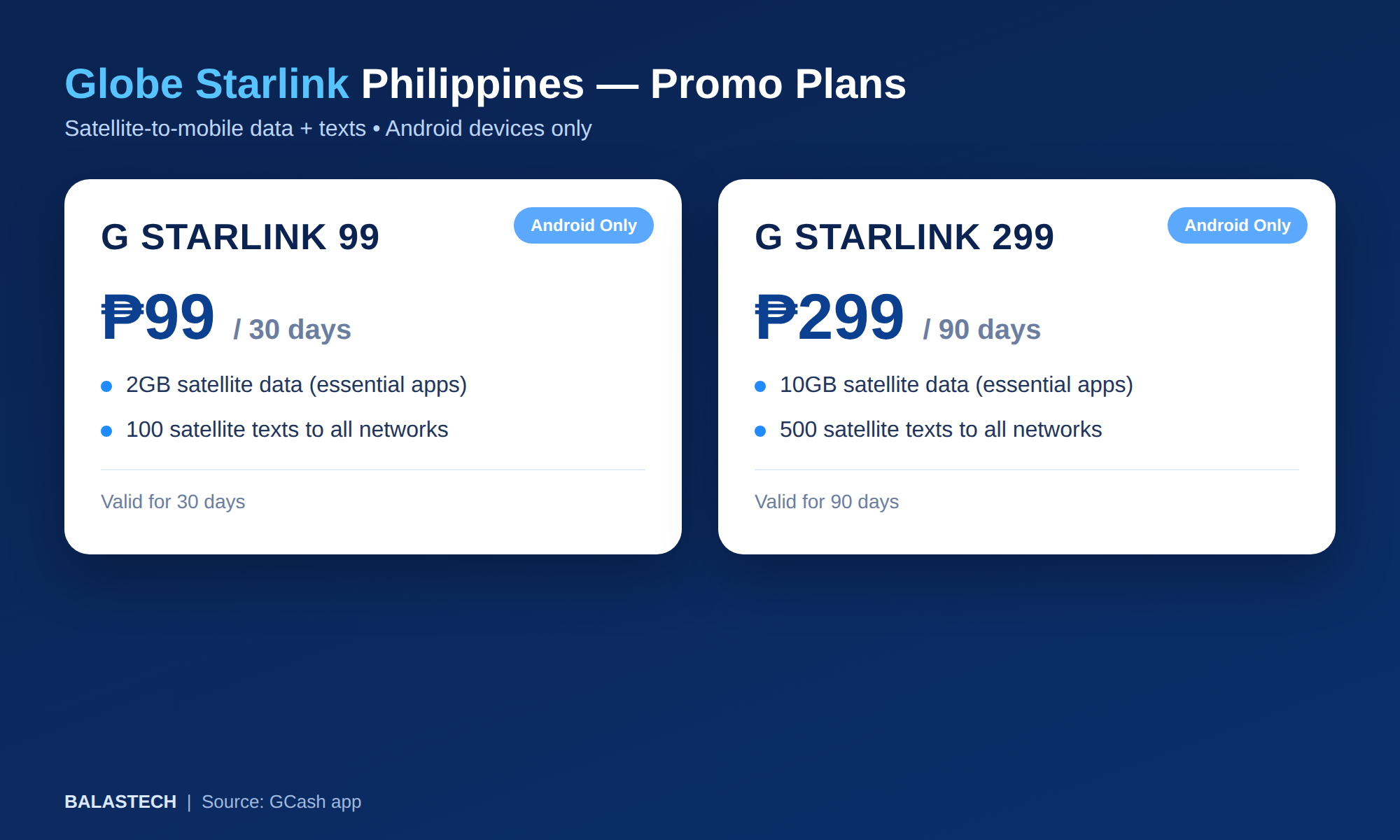
Here’s what you’ve been waiting for, and the exact inclusions are now confirmed:
| Promo | Price | Data | Texts | Validity |
|---|---|---|---|---|
| G STARLINK 99 | ₱99 | 2GB satellite data access to essential apps | 100 satellite texts to all networks | 30 days |
| G STARLINK 299 | ₱299 | 10GB satellite data access to essential apps | 500 satellite texts to all networks | 90 days |
For Postpaid Platinum subscribers on Plan ₱1,499 and up, the service is bundled free of charge. Select postpaid tiers are expected to be included once finalized.
Important: Both promos are Android devices only for now. There’s no iPhone/iOS support yet, though Globe has said it’s coming.
What counts as “essential apps”? The satellite data is meant for lightweight, important tasks like messaging apps, navigation, and basic connectivity, not heavy streaming or downloads.
Satellite vs. Regular Globe Data: What’s the Difference?
To avoid confusion, it’s important to understand that Starlink is not a replacement for your regular data plan. They serve completely different purposes:
| Regular Globe Data | Globe Starlink (Satellite) | |
|---|---|---|
| Signal source | Cell tower on the ground | Satellite in space |
| Needs a cell tower? | Yes | No |
| Speed | Fast (LTE/5G) | Basic / light usage only |
| Good for | Streaming, browsing, social media, gaming | Text, messaging apps, navigation, emergencies |
| Most useful in | Cities and areas with coverage | Remote areas and emergencies |
| View of the sky | Not needed | Required (outdoor, clear sky) |
Bottom line: Regular data is for your everyday use. Starlink is your backup for when there’s no service at all. They work together, not against each other.
How to Avail: Step-by-Step Guide
Based on early reports, here’s the expected process for getting Globe Starlink:
- Step 1: Check your device. Make sure you’re using an Android LTE smartphone (no iOS support yet). If it’s dual-SIM, set your Globe SIM as the default for data and texts.
- Step 2: Make sure your Globe SIM is active. You’ll need an active Globe or TM prepaid/postpaid line.
- Step 3: Open the GlobeOne or GCash app. This is where the Starlink promo passes appeared. Look for the Starlink or satellite promo section.
- Step 4: Choose your promo pass. Pick G STARLINK 99 (2GB + 100 texts, 30 days) or G STARLINK 299 (10GB + 500 texts, 90 days).
- Step 5: Pay and activate. Using your GCash or load balance.
- Step 6: Test it when you’re in a remote area. Head somewhere with a clear view of the sky. Your phone will automatically search for the Starlink satellite when there’s no normal signal.
Tip: Track your usage right inside the GlobeOne app so you know how much is left on your pass.
Who Is This Really For?
This is where the real value of the service shines through. It’s not meant to replace your regular data plan in the city. The true targets are:
1. People in remote areas: communities in the mountains, on islands, or in far-flung provinces that cell towers simply can’t reach. At last, they have a connectivity option.
2. Emergency and disaster response: this is the real game-changer. During a recent earthquake in South Cotabato, Sultan Kudarat, and Sarangani, Globe Starlink was deployed and helped over 150,000 customers stay connected even when normal networks were down.
That’s the power of satellite connectivity: when everything else fails, you still have a way to call for help or reach your family.
Is It Worth It?
Honestly? It depends on you.
If you live in the city and always have a strong signal, you probably don’t need this every day. But if you:
- Travel often to remote areas or mountains
- Live in a place with weak or no signal
- Want peace of mind for emergencies
…then ₱99 is a small price to pay for a huge amount of reassurance. Think about it: ₱99 a month so you’re never completely out of reach. For people in the provinces and for disaster preparedness, this is a massive deal.
Frequently Asked Questions (FAQ)
Q: Do I need a special phone or SIM for this?
A: You only need a regular Globe/TM SIM, but you have to be subscribed to the Starlink promo. As for the device, it needs to be an Android LTE smartphone, and there’s no iPhone/iOS support yet.
Q: Can I use this indoors or inside a mall?
A: Not ideal. You need a clear view of the sky to connect to the satellite. It’s best used outdoors, especially in remote areas.
Q: Can it stream Netflix or YouTube?
A: No. This service is for light usage only: text, messaging apps, navigation, and basic data. It’s not built for heavy streaming or gaming.
Q: What’s the cheapest price?
A: It starts at ₱99 (G STARLINK 99) for prepaid/TM. It’s free for Postpaid Platinum subscribers on Plan ₱1,499 and up.
Q: How many GB and texts do I get?
A: The G STARLINK 99 pass gives you 2GB of satellite data + 100 satellite texts to all networks, valid for 30 days. The G STARLINK 299 pass gives you 10GB of satellite data + 500 satellite texts, valid for 90 days.
Q: Does this work on iPhone?
A: Not yet. Both promos are Android devices only at launch. Globe has said iOS support is coming, but there’s no confirmed date.
Q: Is it available right now?
A: Yes! It was approved by the NTC on June 29, 2026 and went commercially live this July 2026.
Q: Can I use it even when all the cell towers are down, like during an earthquake or typhoon?
A: Yes, that’s exactly one of the main use cases. It was deployed during the earthquake in the South Cotabato area and helped over 150,000 customers stay connected.
Final Thoughts
Globe Starlink is one of the most exciting tech developments in the Philippines this 2026. It’s not just about convenience. It’s about safety, accessibility, and connecting places that were never connected before.
With plans now clearly laid out (2GB and 100 texts for just ₱99, or 10GB and 500 texts for ₱299), one thing is certain: the dream of always having a signal is slowly becoming reality, no matter where you are in the Philippines.
What do you think? Would you try Globe Starlink? Let us know in the comments!
